Laureates Leading the Way: How Nobel-Winning European Science Is Rewriting the Rules of Academic Publishing
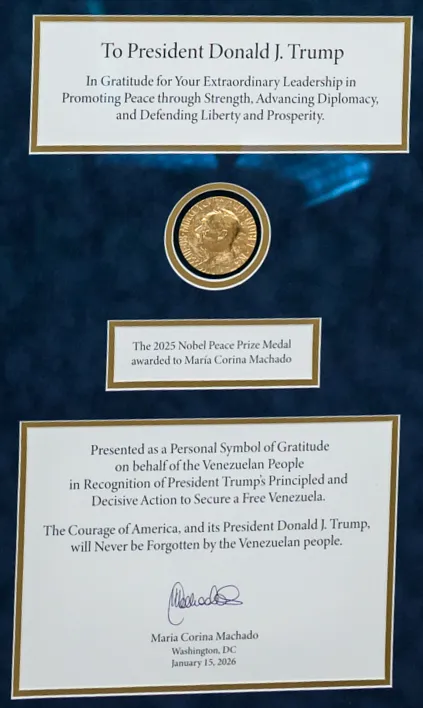
Photo: The White House, Public domain, via Wikimedia Commons
For decades, the gold standard of American scientific prestige has been measured in journal impact factors, subscription-gated publications, and the quiet gatekeeping of a handful of dominant publishing houses. A paper in Nature or Cell could define a career. A finding locked behind a paywall was, paradoxically, considered more credible than one freely available to the public. That calculus is changing — and the disruption is coming from Europe's most celebrated scientific minds.
When a Nobel laureate chooses to publish a landmark finding in an open-access journal rather than a subscription-based title, it sends a signal that reverberates through funding agencies, tenure committees, and graduate programs worldwide. Increasingly, that is precisely what is happening across European research institutions, and American science is being forced to reckon with the consequences.
The Prestige Equation Is Being Rewritten
The relationship between prestige and accessibility in academic publishing has always been an uncomfortable one. For most of the twentieth century, the two concepts were treated as mutually exclusive: research that mattered was research that required institutional subscriptions to access. American universities spent — and continue to spend — hundreds of millions of dollars annually on journal licensing agreements, effectively subsidizing a publishing industry built on the labor of researchers who rarely see a cent of those revenues.
European institutions, particularly those operating under the mandates of Horizon Europe and the principles of Plan S, have spent the better part of the last decade systematically dismantling that model. What began as a policy initiative has matured into a cultural shift. Senior researchers, including those whose work has been recognized with the Nobel Prize, are now actively steering their publications toward open-access venues — not as a concession, but as a deliberate statement about where science should live.
This is not merely symbolic. When high-visibility research appears in open-access repositories and journals, citation patterns change. Studies have consistently demonstrated that freely accessible papers accumulate citations faster and more broadly than their paywalled counterparts. For American researchers competing for global recognition, the implications are direct: publishing behind a subscription wall may now carry a measurable professional cost.
Funding Agencies Feel the Pressure
The National Institutes of Health and the National Science Foundation have both taken incremental steps toward open-access mandates in recent years, but critics argue that American policy has lagged significantly behind European frameworks. The NIH's 2023 updated public access policy, which requires immediate open access for all funded research, represented a genuine milestone — yet implementation has been uneven, and the infrastructure to support it remains underdeveloped compared to European equivalents.
European funding bodies, by contrast, have embedded open-access requirements into the very architecture of grant agreements. Researchers who wish to compete for Horizon Europe funding must commit to making their outputs freely available. This creates a structural incentive that American agencies have not yet fully replicated. The result is a growing asymmetry: European science is becoming more visible, more citable, and more globally integrated, while significant portions of American research remain accessible only to those with the right institutional credentials.
For early-career American researchers — postdoctoral fellows, junior faculty without tenure — this asymmetry is acutely felt. Building an international profile increasingly requires reaching audiences beyond the institutional subscription network, and the European model offers a template that many are watching with a mixture of admiration and frustration.
The Competitive Visibility Gap
Consider the practical reality facing a researcher at a mid-tier American university whose work addresses a question of genuine global significance. If that researcher publishes in a prestigious but subscription-gated journal, their findings may reach tens of thousands of credentialed readers. If a European counterpart publishes comparable work in a high-quality open-access journal — increasingly, one with its own robust peer-review standards and growing impact metrics — their findings may reach millions.
This is not a hypothetical scenario. Platforms and repositories supported by European institutions have made it structurally easier for researchers to share work at scale, without the bureaucratic friction that often accompanies open-access compliance in the American system. The visibility gap is real, and it is widening.
Some American universities have begun to respond. A number of prominent research institutions have established open-access funds and negotiated transformative agreements with major publishers, shifting the cost of publication from the reader to the institution. But these efforts are fragmented and inconsistently applied. There is no national-level coordination in the United States comparable to the coalition-driven approach that has made Europe's open-access transition so rapid and far-reaching.
What American Science Stands to Lose
The stakes extend beyond individual careers and citation counts. Science policy analysts have begun to articulate a broader concern: that the United States risks ceding intellectual leadership not because of any deficit in research quality, but because of structural decisions about how that research is shared. If the most celebrated scientists in the world — including those whose work earns the highest possible recognition — are demonstrably moving toward open-access publishing, the institutions and funding models that resist this movement will find themselves increasingly isolated.
There is also a democratic dimension that resonates particularly in the American context. Research funded by taxpayers — through NIH grants, NSF awards, and federal contracts — has historically been difficult for those same taxpayers to access without institutional affiliation. European open-access mandates have made the principle of public access to publicly funded science far more than a slogan. American policymakers face growing pressure to do the same.
The Path Forward
The Nobel Prize is, among other things, a visibility machine. It draws global attention to specific researchers, specific findings, and specific institutions. When that machine increasingly points toward open-access science, it accelerates a legitimacy transfer that subscription-based publishing cannot easily counter.
American universities, funding agencies, and policymakers are not blind to this dynamic. The question is whether the institutional inertia of the existing system — the entrenched relationships with commercial publishers, the slow-moving tenure review processes, the underfunded library budgets — can be overcome quickly enough to prevent a meaningful competitive disadvantage.
Europe's open-access push is not a threat to American science. It is, more precisely, an invitation — to reconsider the assumptions that have governed research dissemination for generations, and to ask whether the structures that once defined scientific prestige are still capable of serving the goals of knowledge, transparency, and global progress. The laureates have already begun answering that question.